Lightweight
wheels are without a doubt the best performance
product you can purchase for your motorcycle.
Instant performance is gained in all major
areas and it is something the rider feels,
so they notice instant benefits.
When comparing wheels and weights, it is not
always the overall wheel weight that matters,
but rather the weight distribution in each
particular wheel which affects the performance
of the wheel and, therfore, the bike; i.e.
a lighter rim = better performance. Carbon
wheels generally have much lighter rims and
carry the bulk of their weight in the hub
– and the hub has little effect on the
performance of the wheel. Often, unfair comparisons
are made between wheels which are completely
different e.g. a forged magnesium race wheel
versus carbon road wheel, which is designed
for road use. Interestingly, even if they
did weigh the same, the carbon wheel will
still have better performance – remember
the lighter rim. In most cases the carbon
road wheel is still lighter than a forged
race wheel: the carbon part of a BST road
front wheel weighs only + 1.450 kg. Of that,
the outer rim is only + 1.100kg. The completed
wheel weighs between 2.2 kg and 2.4 kg (depending
on the motorcycle). Therefore, you have a
wheel with an incredibly light rim and the
weight of the hub at the centre, which gives
you a high performing wheel.
It's important to compare like-for-like in
order to get a proper picture: ie compare
a 16.5” carbon race wheel to a 16.5”
magnesium race wheel. The size of the wheel
makes a fundamental difference as the distance
from the rim to the hub affects the performance
(more on this later) and, of course, more
material is used to produce the bigger wheel,
thus increasing its weight.
In recent tests, BST carbon race wheels
were compared to team supplied lightweight
GP wheels (wheels were the same size and for
the same bike):
Carbon race front wheel was 15% lighter but
had a 25% better inertia figures .
Carbon race rear wheel was 10% lighter but
had 33% better inertia figures .
Reducing the weight of your wheels is the
most effective and therefore most important
performance change you can make to your motorcycle.
But weight is NOT the only consideration,
and this is where BST Carbon wheels excel:
Lighter wheels will make a major difference
to the handling of your bike but they will
also improve your acceleration and deceleration
(braking) of your bike.
Why is this the case?
Let's have a look at some basic calculations:
Any object that has a mass and that moves
at a velocity has a certain energy, which
is coming directly from your engine. If you
move a wheel at a certain speed (i.e. no rotation
of the wheel) the energy can be calculated
using the following formula:
E = 1⁄2 m v2
m being the Mass and v
being the Velocity at which the wheel moves.
If the wheels is also turning - as is naturally
the case on a motorcycle - the total energy
is made up from two components, namely the
translational (moving) part and the rotational
(turning) part. The new formula looks like
this:
E = 1⁄2 m v2 + 1⁄2 J w2
J being the Rotational Inertia
and w being the Rotations
per Second.
The rotational Inertia is made up of the mass
of the object and the distance it is away
from the rotating axis. Remember the flywheel
effect: the further the mass is away from
the axis, the more energy it takes to accelerate
or brake it. If the mass is twice the distance
away from the axis, it will require 4 times
as much energy (or engine power) to accelerate
and brake.
Example :
0.1 kg (or approx 1 N) which is 20 mm away
from the axis will have a Rotational moment
of Inertia of 40.
If you have the same weight 40 mm away from
the axis the Moment of Inertia will be 160
(factor of 4).
So how does this exercise look when
applied to wheels?
The weight of the wheels is not the only consideration:
what is much more important is the Rotational
Inertia of the wheels, namely how much weight
is close to the axle and how much weight is
far away from the axle.
The following Graphs will show the difference
between some wheel weights and Inertia Values:
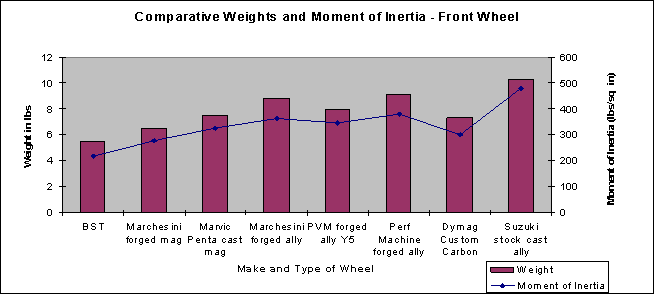
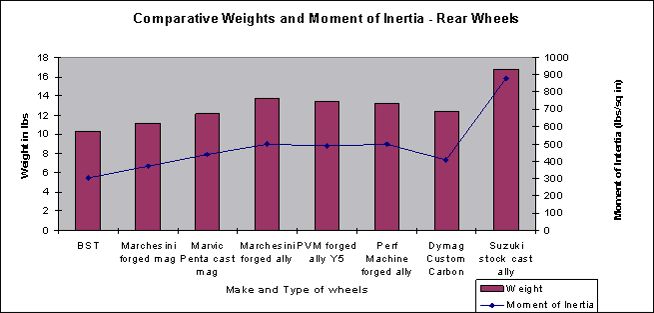
Graphs show all wheel weights
as a % of the standard aluminium wheels as
actually measured on a Suzuki GSXR1000 - weights
may change depending on model.
Weights and MoI measurements by Sport Rider
Magazineand published in their February 2004
edition.
How does this affect your performance?
The energy needed to turn these wheels obviously
comes from the engine. If you need less energy
or power to turn your wheels, the available
power accelerates the wheel quicker and you
will end up with a higher maximum speed. But
how much power can be saved by using Carbon
wheels?
| Example |
Total
weight |
Front
3.5" x 17" |
Rear
6" x 17" |
| Std
set cast Aluminium wheels |
10
kg |
3.5kg |
6.5kg |
| BST
Carbon Race wheels |
5kg |
2.1kg |
2.9kg |
| |
|
|
|
| Weight
saving |
5kg
or 100% |
|
|
| Inertia
saving |
140% |
|
|
| Power
saving to accelerate wheels from 0 to
200 km in 10 seconds |
3KW
or 5hp |
|
|
| Increase
in top speed |
4-7
km/h |
|
|
| Decrease
in lap time (2.5+ mile/GP length lap,
circuit dependant) |
2
- 3.5 secs |
|
|
Handling and Gyroscopic
effects
How do wheels affect your handling?
The lighter the wheels, the less your unsprung
mass. This means suspension has to work less
to dampen the wheels. This will result in
less energy and less power being consumed
from the engine.
It is more difficult to move or steer a rotating
mass than a is stationary mass (try to move
a spinning bicycle wheel). If you reduce the
mass and specifically the rotating inertia,
the force required to move or steer the mass
is reduced significantly. Putting lighter
wheel s on your bike will reduce the steering
forces a lot and therefore have a significant
positive influence on rider fatigue. Try to
workout in a gym with half the weight and
see how much longer you can last.
Summary: BST Carbon wheels
will give you significant performance improvement,
and better and quicker (crisper) handling
at lower steering forces which will result
in less rider fatigue.
No other performance enhancing product
will give you the same benefit/price ratio.
Please remember to always use the correct
wheel for your application - race or street.
|

